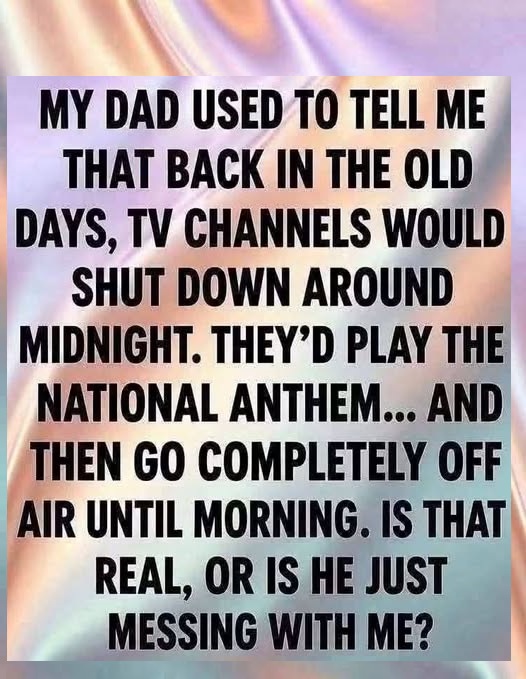
For anyone who grew up in the era of endless streaming, 24-hour cable news, and late-night binge-watching, the idea of television simply “turning off” sounds like a myth.
A viral post circulating online asks: “My dad used to tell me that back in the old days, TV channels would shut down around midnight. They’d play the National Anthem… and then go completely off air until morning. Is that real, or is he just messing with me?”
Your dad is not messing with you—this practice was real. For several decades of broadcasting history, television stations routinely concluded their daily programming schedules late at night with an official “sign-off.”
In this guide, we will explore the history of TV sign-offs, why stations went off the air, and how 24-hour broadcasting eventually replaced this nostalgic ritual.
What Happened During a TV Sign-Off?
Until the late 1970s and 1980s, many local television stations and network affiliates, including NBC, CBS, and ABC affiliates, did not broadcast around the clock. Instead, often between 11:30 PM and 1:00 AM, a station would air a sequence to mark the end of its broadcast day.
- Station Identification: An announcer would read the station’s official call letters, operating frequency, and main studio location.
- The National Anthem: A video clip—often featuring flying flags, military aircraft, or natural landmarks—played alongside a recorded rendition of “The Star-Spangled Banner.”
- The Test Pattern: After the anthem concluded, viewers might see a television test pattern, such as color bars, sometimes accompanied by a steady test tone.
- Static or Snow: Depending on the station and its equipment, the broadcast might end completely, leaving viewers with a blank screen or the familiar static, often called television “snow.”
Why Did TV Stations Go Off the Air?
The nightly sign-off was more than a tradition. It was connected to practical economic and technical considerations.
1. High Equipment and Operational Costs
Operating high-power television transmitters required electricity and ongoing maintenance. When overnight audiences were small, broadcasting throughout the night could be less financially attractive for station owners, particularly when there was limited programming available.
2. Required Technical Maintenance
Analog-era broadcast equipment relied on complex transmitters and electronic components that needed regular servicing. Overnight breaks could provide technicians with an opportunity to inspect, calibrate, and maintain equipment.
3. Limited Overnight Programming
In television’s early decades, stations had fewer options for filling overnight airtime with syndicated reruns, infomercials, and other programming. Ending the broadcast day was one way to manage schedules when there was little demand for additional content.
The Transition to 24/7 Television
Television gradually moved away from scheduled sign-offs as cable networks, satellite distribution, and overnight programming expanded.
| Period | Broadcast Landscape | Overnight Status |
|---|---|---|
| 1950s–1970s | Major networks and local affiliates dominated television | Many stations signed off overnight |
| Late 1970s | Satellite and cable television expanded | Some channels began offering extended schedules |
| 1980s | 24-hour news, music television, reruns, and infomercials became more common | More channels stayed on the air overnight |
| 1990s–Present | Digital television, cable, streaming, and on-demand services expanded | Traditional nightly sign-offs became much less common |
The transition did not happen everywhere at the same time. Some stations continued signing off after others had adopted round-the-clock schedules, and broadcasting practices varied by market and country.
Conclusion
The midnight television sign-off is a fascinating piece of broadcasting history that many viewers remember with nostalgia. Before 24-hour programming became common, some stations ended their daily schedules with an announcement, the national anthem, and a final screen before returning the following morning.
Today, viewers can access live television, streaming platforms, and on-demand entertainment at almost any hour. That makes the old tradition of a television station signing off for the night seem unusual—but it was once a familiar part of watching TV.
Frequently Asked Questions
When did TV stations stop playing the National Anthem at night?
There was no single date when every station stopped. Many stations phased out traditional nightly sign-offs as overnight programming became more common during the 1980s and 1990s, although the timeline varied by station and region.
What was the purpose of the colored test pattern screen?
Test patterns helped broadcast technicians check and adjust television picture quality, including alignment, color, and sharpness. They also became a familiar sight to viewers when a station was not showing regular programming.
Did every television channel shut down at midnight?
No. Sign-off practices varied. Some stations stopped broadcasting overnight, while others operated for longer hours or offered continuous programming. The exact schedule depended on the station, its market, and the period.
Why did television stations begin broadcasting 24 hours a day?
The growth of cable and satellite television, the rise of 24-hour news and music channels, and the availability of reruns and infomercials made overnight broadcasting more practical and commercially attractive.
What did viewers see after a station signed off?
Depending on the station and its equipment, viewers might see a test pattern, a blank screen, or television static. The precise sequence was not identical across every broadcaster.