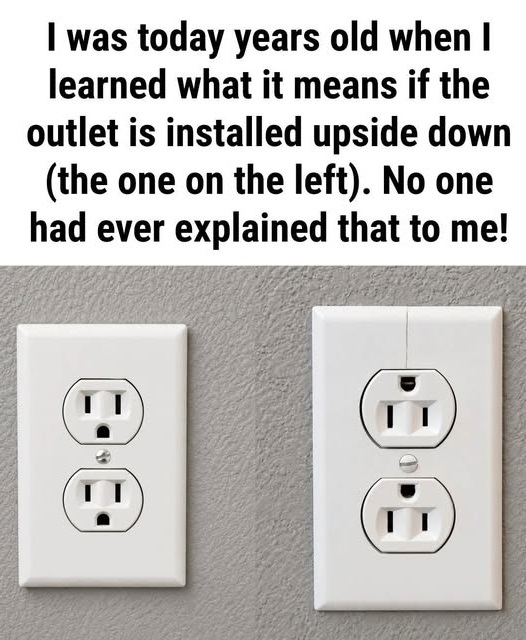
If you’ve ever noticed an electrical outlet installed upside down, you may have assumed it was a mistake. In reality, many electricians do it intentionally for practical safety reasons that most homeowners never hear about.
The first time I noticed an upside-down electrical outlet, I was completely confused.
I was visiting a friend’s newly renovated home when I plugged my phone charger into the wall. As I looked down, something immediately caught my attention.
The outlet looked backward.
Instead of the round grounding hole being at the bottom like I had always seen, it was positioned at the top.
My first thought was simple.
“The electrician must have installed it the wrong way.”
I didn’t mention it because it didn’t seem like a big deal.
I plugged in my charger, finished what I was doing, and forgot about it.
Or at least I thought I had.
Months later, while reading an article about electrical safety, home improvement, and common household mistakes, I came across an explanation that completely changed the way I looked at those outlets.
It wasn’t installed incorrectly.
It had been installed that way on purpose.
And once I learned the reason behind it, I couldn’t believe no one had ever explained it to me before.
Why Are Some Electrical Outlets Installed Upside Down?
Although most homes have outlets with the grounding hole at the bottom, some electricians intentionally install them with the grounding pin at the top.
The reason is surprisingly practical.
Better Protection If a Metal Object Falls
Imagine plugging a cord into the outlet without pushing it in completely.
If a metal object—such as a key, necklace, screwdriver, or ruler—falls between the wall and the partially inserted plug, it could touch the energized prongs.
When the grounding pin is positioned at the top, the falling object is much more likely to hit the ground pin first instead of the live electrical contacts.
That simple difference can help reduce the chance of a dangerous electrical short.
An Extra Layer of Electrical Safety
Another reason some professionals prefer this orientation is that it provides an additional level of protection if something accidentally contacts the plug while it’s partially inserted.
Although no outlet installation completely eliminates electrical hazards, positioning the grounding pin at the top can reduce certain types of accidental contact.
It’s a small design choice that may provide added peace of mind in everyday situations.
A Common Choice in Hospitals and Commercial Buildings
Many hospitals, healthcare facilities, and commercial buildings use outlets installed with the grounding hole facing upward.
This practice is often associated with environments where electrical safety receives extra attention and reducing potential hazards is especially important.
That’s one reason many electricians refer to this orientation as the “hospital-style” installation.
It Isn’t an Installation Mistake
One of the biggest misconceptions is assuming an upside-down outlet means poor workmanship.
In reality, many licensed electricians install outlets this way intentionally.
It’s simply a different orientation—not an error.
Why Are Most Home Outlets Installed the Traditional Way?
If the upside-down position offers potential safety benefits, many homeowners wonder why it isn’t used everywhere.
The answer has more to do with tradition than performance.
For decades, residential electricians have commonly installed outlets with the grounding hole at the bottom.
As a result, that’s the appearance most people recognize.
Because homeowners are familiar with that layout, many builders continue using it simply for consistency and appearance.
Another important point is that the National Electrical Code (NEC) does not require a single orientation for standard wall outlets.
As long as the outlet is installed correctly and meets applicable electrical codes, either position is generally acceptable.
That means the final orientation often depends on the electrician, builder, or property owner’s preference.
In many commercial buildings, schools, medical facilities, and office spaces, however, you’ll often notice the opposite orientation being used more frequently.
For professionals in those settings, the decision is often based on practical safety considerations rather than appearance.
⚠️ Don’t miss the rest! The full article continues on the next page 👇📖
Tap “Next Page” to see all the details, tips, and surprises waiting for you!