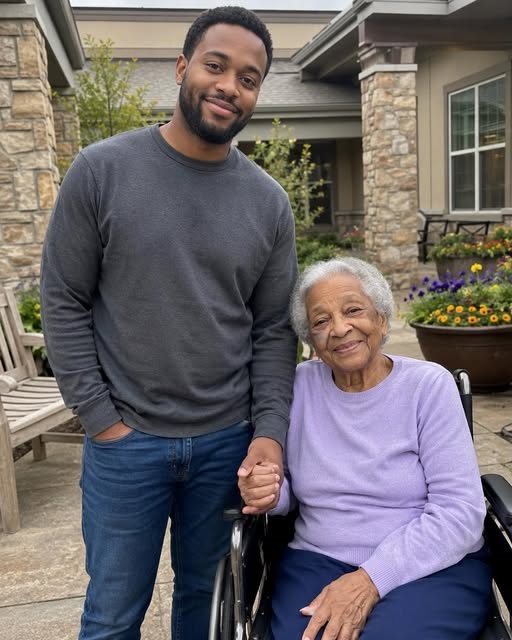
Daniel never imagined that pretending to be someone else would alter his life forever. What started as a desperate way to pay for his mother’s medical bills became an emotional bond he never expected. And when the elderly woman he visited passed away, she left behind one final request that stunned everyone.
The dashboard clock glowed 11:47 p.m. as I parked my delivery van outside my mother’s apartment building.
Rain streaked across the windshield, turning streetlights into blurry golden smears. I sat there for a moment, mentally calculating expenses.
Rent.
Utilities.
Groceries.
Medication.
No matter how many times I did the math, the result never changed.
I was falling behind.
Grabbing a grocery bag and a small pharmacy package, I climbed the narrow staircase to the third floor.
My mother opened the door before I could knock.
She always did.
“You shouldn’t be out this late, sweetheart,” she said.
“I’m alright, Mom. I brought your blood pressure medicine and that chicken soup you like.”
She gently cupped my face with both hands.
“You look exhausted, Daniel.”
“I’m fine.”
But I wasn’t.
Not even close.
The following morning, between delivery routes, I stopped at a small café for coffee.
That was where everything began.
A sharply dressed man sat across from me without asking permission.
“You’re Daniel, right?” he asked.
I nodded cautiously.
“A mutual acquaintance mentioned you might be interested in making some extra money.”
I should have walked away.
Instead, I stayed.
The man introduced a proposition that immediately made me uncomfortable.
“My mother lives in a care facility,” he explained. “Her name is Evelyn. She has dementia. Most days she believes her son never visits her.”
“So visit her,” I replied.
His jaw tightened.
“I can’t.”
He slid a thick stack of cash across the table.
“I’ll pay you five hundred dollars a week. Visit her on weekends. Pretend you’re me. My name is Brandon.”
I stared at the money.
“This feels wrong.”
“Wrong doesn’t pay hospital bills.”
The words hit exactly where he intended.
Because he knew about my mother.
And he knew I was desperate.
I should have refused.
Instead, I accepted.
That Saturday, I arrived at Green Meadows Care Home.
The hallways smelled faintly of disinfectant and flowers.
Room 214.
I knocked softly before stepping inside.
An elderly woman sat beside the window with a blanket draped across her lap.
She slowly lifted her eyes.
“Mama,” I said nervously. “It’s me. Brandon.”
For several long seconds she studied my face.
Then she smiled.
A genuine smile.
“There you are.”
She reached for my hand.
Instantly, guilt washed over me.
I expected the visits to feel like a performance.
Instead, they felt painfully real.
Evelyn asked if I was sleeping enough.
If I was eating properly.
If work was treating me well.
Simple questions.
Yet nobody had asked me those things in years.
Each weekend became easier.
Then weekends became weekdays too.
I started bringing flowers.
Chocolate.
Books.
Sometimes I simply sat beside her and listened.
One afternoon in the hallway, another resident stopped me.
Her name was Clara.
“You visit Evelyn more than anyone,” she observed.
“She’s my mother,” I replied automatically.
Clara smiled sadly.
“Then you’re luckier than most people.”
The comment stayed with me.
Weeks turned into months.
I kept returning.
Not because Brandon was paying me.
Because Evelyn waited for me.
One afternoon she grabbed my hand and looked directly into my eyes.
Clear-eyed.
Focused.
More lucid than I’d ever seen her.
“You’re a good man, son.”
Emotion caught in my throat.
“Mama, I…”
She squeezed my hand gently.
“I know what I know.”
At the time, I assumed it was the dementia talking.
I was wrong.
Two days later, the call came.
Evelyn had passed away peacefully during the night.
The care home’s director, Patricia, asked me to come in.
“She left something for you,” she said.
Confused, I sat across from her desk.
Patricia placed a sealed envelope in front of me.
Then she said something that stopped my heart.
“She knew you weren’t her son.”
I stared at her.
“What?”
“From the very first visit.”
My hands trembled as I opened the letter.
Inside was a handwritten note.
“My dear boy who was never truly my boy,
My memory failed me many times, but my heart never did.
I knew you were not Brandon.
I knew from the beginning.
But I also knew something else.
You stayed.
That was enough.
The key enclosed opens something I saved long ago.
Use half of it to help the people who still live here.
They need kindness more than money.
Love,
Evelyn.”
A small brass key slipped from the envelope into my hand.
Days later, Brandon appeared at my apartment furious.
“Where’s the key?”
“It’s not yours.”
His face darkened.
“She was my mother.”
“Then where were you?”
He had no answer.
Instead, he hired lawyers.
He claimed I manipulated a vulnerable woman.
Soon I was facing legal threats, accusations, and court papers.
The pressure became overwhelming.
One evening, sitting beside my mother, I considered giving up.
She listened quietly before speaking.
“You have something they don’t.”
“What?”
“The truth.”
The court battle lasted weeks.
Fortunately, Patricia, Clara, nurses, caregivers, and visitor logs all told the same story.
Evelyn had known exactly who I was.
Clara testified.
“Evelyn called him ‘the boy who chose to stay.’ She knew he wasn’t her son.”
Then Brandon took the stand.
His lawyer tried portraying him as a grieving son.
But under questioning, the truth emerged.
He admitted paying me.
Admitted avoiding visits.
Admitted he hadn’t spent meaningful time with his mother for years.
The judge reviewed Evelyn’s letter carefully.
Finally, she delivered her decision.
“The bequest stands.”
Just like that, the case was over.
A few days later, I visited the bank and opened the safety deposit box.
Inside were savings bonds, cash, personal keepsakes, and a faded photograph of a young Evelyn holding her infant son.
Tears blurred my vision.
I reread her final instructions.
Half would go to the residents of Green Meadows.
The other half allowed me to pay every medical bill my mother owed.
For the first time in years, I slept peacefully.
No calculations.
No panic.
No fear.
Every Saturday afterward, I continued visiting the care home.
Clara always reserved a chair for me near the window.
One afternoon, I placed a bouquet of tulips on Evelyn’s old seat.
The sunlight poured across the empty chair.
Clara looked at me quietly.
I smiled.
“She taught me something.”
“What was that?”
I looked at the flowers.
“She taught me that family isn’t always the people we’re born to.”
Clara nodded.
“And sometimes,” I continued softly, “the people who stay become family anyway.”
The sunlight moved slowly across the petals as we sat there in comfortable silence, remembering the woman who changed both our lives forever.