Isaiah Mitchell woke every morning before sunrise, not because he was disciplined, but because sleep had stopped giving him much.
His penthouse overlooked Lake Michigan, and on clear mornings the water reflected the sunlight so perfectly it looked like a sheet of molten gold stretching to the horizon.
Most people loved the view.
Guests talked about it.
Investors admired it.
Women he dated photographed it.
Isaiah barely looked at it.
By six o’clock he was already dressed, answering emails and preparing for another day of meetings worth more money than he ever imagined possible as a child.
The espresso machine in his kitchen cost more than some people’s used cars.
He pressed a button, listened to the machine hum, and walked away before the coffee finished pouring.
That was how he handled most things that were supposed to make him happy.
He bought them.
He achieved them.
Then he ignored them.
His apartment looked less like a home and more like a showroom.
No family photos.
No childhood memories.
No framed awards.
Nothing that suggested a life had actually been lived there.
Except for one thing.
Locked inside a drawer in his office was a small glass frame.
Inside rested half of a faded red ribbon.
Its color had long ago faded from bright red to rusty pink.
Its edges were worn.
Its threads had loosened with age.
Yet it was the most valuable thing Isaiah owned.
Every morning he opened the drawer and looked at it.
Every morning he asked the same silent question.
Where are you now?
The ribbon belonged to a girl he had not seen in twenty-two years.
A girl who had changed his life with nothing more than a sandwich.
Back then, Isaiah was nine years old.
His mother, Colleen, was struggling to survive after losing their apartment.
They moved from shelter to shelter, couch to couch, carrying everything they owned inside a worn duffel bag.
Some days his mother worked two cleaning jobs.
Some days she worked none.
Most days she worried constantly.
Because they had no stable address, Isaiah wasn’t enrolled in school for several months.
While his mother handled paperwork or searched for work, she often left him near Lincoln Elementary School because it was safer than many other places they could wait.
That was where he first saw her.
Victoria Hayes.
She was nine years old too.
Small for her age.
Bright-eyed.
Always wearing neat braids tied with red ribbons.
She lived with her mother, Laverne, in a tiny apartment above a laundromat.
Life wasn’t easy for them either.
Money was always short.
Bills were always late.
And every meal required careful planning.
But unlike Isaiah, Victoria still had something dependable.
School lunch.
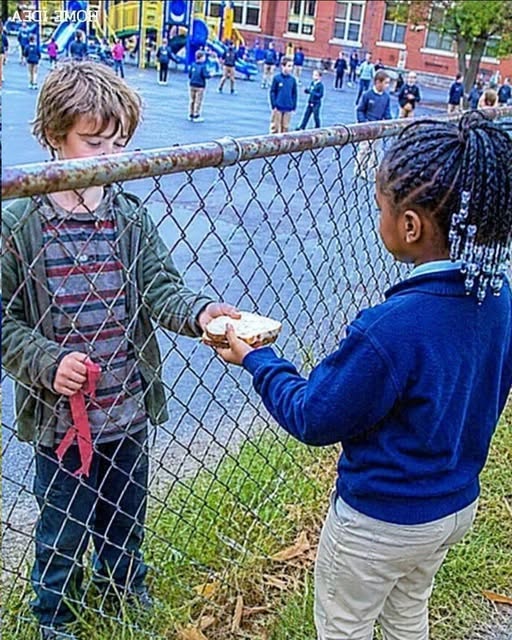
One windy October afternoon, she sat outside during lunch break eating a sandwich wrapped in wax paper.
When she looked up, she noticed the skinny boy standing behind the chain-link fence.
He wasn’t looking at her face.
He was looking at the sandwich.
And he was trying desperately not to.
That was what stayed with her.
Not the hunger itself.
The way he was trying to hide it.
Victoria stood up.
Walked toward the fence.
And pushed the sandwich through an opening near the bottom.
“Take it,” she said.
Isaiah stared at her.
No one had ever done something like that before.
“Go on,” she insisted.
Slowly, he reached for it.
The first bite nearly made him cry.
He tried eating slowly.
Tried pretending he wasn’t starving.
But hunger always wins.
Victoria handed him her apple too.
The bell rang moments later.
She walked back inside.
And Isaiah stood there holding the apple, wondering why a stranger had cared.
The next day she did it again.
And the day after that.
Then again.
And again.
What started as one sandwich became a routine.
Every lunch period, Isaiah waited by the fence.
Every lunch period, Victoria found a way to bring him food.
Sometimes half a sandwich.
Sometimes the whole thing.
Sometimes pretzels.
Sometimes fruit.
Whatever she had.
Whatever she could spare.
Neither of them talked much at first.
The exchange felt too important for unnecessary words.
But over time they became friends.
He learned her name.
She learned his.
He told her about moving from shelter to shelter.
She told him about her favorite teacher.
He admitted he loved math because numbers always made sense.
Victoria said her favorite teacher was the one who treated every student equally badly.
That made him laugh.
It was the first genuine laugh she’d ever heard from him.
Winter arrived.
The wind became colder.
The lunches became harder.
And yet Victoria never stopped coming.
What Isaiah didn’t know was that helping him came at a cost.
Her mother eventually noticed something strange.
Victoria came home hungry every afternoon.
She seemed tired.
Weak.
One evening she nearly fainted while helping fold laundry.
Alarmed, Laverne sat her down at the kitchen table.
“What’s going on?”
At first Victoria lied.
Then she cried.
Then she told the truth.
She explained everything.
The boy behind the fence.
The sandwiches.
The hunger.
The friendship.
Laverne listened quietly.
When Victoria finished, she waited for anger.
Punishment.
A lecture.
Instead, her mother closed her eyes and sat silently for several moments.
The next morning she packed two smaller sandwiches.
One for Victoria.
One for Isaiah.
And on some mornings, she skipped breakfast herself.
Neither child knew how much that sacrifice cost.
But years later, Isaiah would never forget it.
Spring eventually arrived.
And life finally began changing.
Colleen was offered a janitorial job in Indianapolis through a distant cousin.
A church organization paid for bus tickets.
For the first time in months, there was hope.
But hope came with a goodbye.
On his final afternoon in Chicago, Isaiah waited by the fence one last time.
Victoria arrived carrying lunch.
Something felt different immediately.
“What’s wrong?” she asked.
“We’re leaving tomorrow.”
For a moment neither of them spoke.
Then Victoria smiled.
“That’s good, isn’t it?”
“Yeah.”
But he didn’t sound convinced.
Because losing a friend felt a lot like losing home.
The two children stood quietly beside the fence.
Then Isaiah said something that surprised even him.
“I won’t always be like this.”
Victoria tilted her head.
“Like what?”
“Poor.”
The answer came instantly.
Like he’d been carrying it for months.
She laughed.
Not because she was cruel.
Because only a child could say something so serious with such certainty.
Isaiah blushed.
But he continued.
“One day I’ll come back.”
“Okay.”
“I’ll be rich.”
Victoria smiled wider.
“Sure.”
“And then I’ll marry you.”
That made her laugh even harder.
Then she did something unexpected.
She reached up.
Untied one of her bright red ribbons.
And tore it in half.
She tied one piece around his wrist.
Then kept the other.
“Don’t forget, then,” she said.
Isaiah looked down at the ribbon.
Then back at her.
“I won’t.”
The next morning he boarded a bus and left Chicago.
But he never forgot.
Not for a single day.
Twenty-two years later, Isaiah Mitchell was worth millions.
His company owned properties across multiple states.
Business magazines called him brilliant.
Investors called him visionary.
Competitors called him dangerous.
Yet every morning he still opened the drawer and looked at half of a faded red ribbon.
Because success had given him almost everything.
Except the one person he never stopped looking for.
And somewhere deep inside, the promise of a hungry nine-year-old boy was still alive.
“I’ll come back.”
And finally…
He was ready to keep that promise.
Continue to Part 2…
⚠️ Don’t miss the rest! The full article continues on the next page 👇📖
Tap “Next Page” to see all the details, tips, and surprises waiting for you!