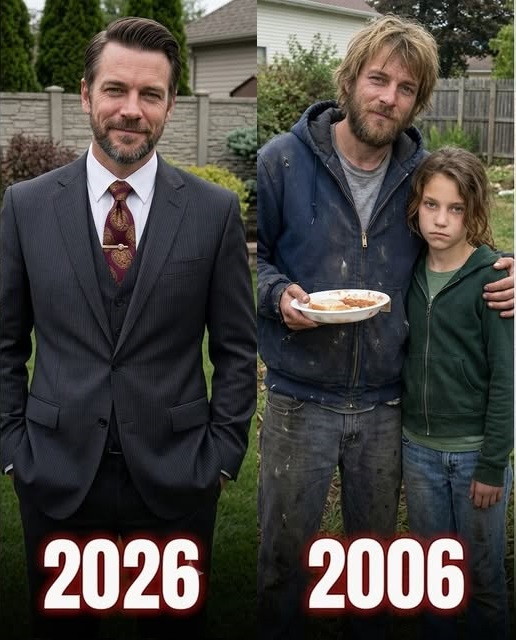
She had been hiding family.
The day after my mother’s funeral, the homeless man who had lived behind our house disappeared.
For most of my childhood, Arthur had stayed behind our modest home in a makeshift shelter built from tarps and salvaged wood. Every single day, my mother brought him food.
When I returned carrying the meal she had begged me to deliver, Arthur was standing beside a dark blue SUV, dressed in a clean coat, holding my mother’s silver locket.
The same one she insisted had vanished when I was eight years old.
“I thought you couldn’t come, Emma,” he said.
I almost dropped the food container.
“Arthur? How?”
Without the beard, he looked older. His eyes were exhausted and rimmed with red.
“I brought dinner,” I said. “But what’s going on?”
His hand tightened around the locket.
“Before she died,” he said, “your mother begged me to stay silent.”
A chill rushed through me.
“About what?”
Arthur glanced toward the kitchen window where Mom used to watch him whenever she thought I wasn’t paying attention.
“About who I am.”
Every afternoon, my mother packed three meals.
Two remained on our worn kitchen table.
The third went into whichever plastic container she had washed and saved for Arthur.
I hated it.
I hated watching tape cover the holes in my sneakers while Arthur received the largest piece of chicken. We were struggling too.
I was eleven when I finally said what had been building inside me.
“He eats better than I do, Mom.”
Mom kept stirring at the stove without looking up.
“Emma, don’t start. Please.”
“Mom, the lights got shut off twice this winter,” I said. “But Arthur gets lunch every day like he’s family.”
The spoon slipped from her fingers and clanged into the sink.
“Don’t say his name like that, Emma. He needs help.”
I crossed my arms. I was cold, hungry, and cruel in the way wounded children sometimes are.
“Why? He’s just some man behind our house.”
Mom turned toward me, her face suddenly drained of color.
“No,” she said. “He isn’t just some man.”
“Then who is he?”
For a moment, I thought she was finally going to answer.
Instead, she pressed the warm container into my hands.
“Take him his food, sweetheart.”
I stared at her.
“Maybe if you stopped feeding strangers, we wouldn’t live like this.”
Mom slammed her palm against the counter so hard that I jumped.
“Don’t you ever say that again. Do you hear me? You have no idea what that man gave up.”
“Gave up for who? You?”
Her body trembled.
Then she turned away.
“Take him his food, Emma. This conversation is over.”
…
My mother’s name was Catherine.
My uncle’s name was Richard.
The neighbor was Mrs. Harper.
And the homeless man everyone ignored for twenty years was Arthur — Catherine’s older brother.
When Richard finally walked out of the house, Arthur remained seated at the kitchen table.
For the first time in twenty years, his meal didn’t leave through the back door.
It stayed at the table.
Where family belonged.