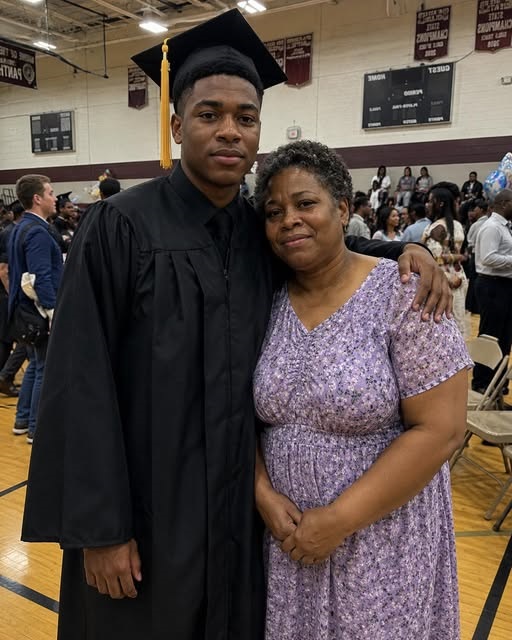
My name is Liam, I’m 18 years old, and for as long as I can remember, my world smelled like bleach, diesel fuel, and garbage bags sitting too long in the summer heat.
My mother never imagined her life would turn out this way.
When she was younger, she dreamed of becoming a nurse.
She was studying nursing, newly married, and building a future with my father in a small apartment they proudly called home.
Then everything changed in a single moment.
My dad worked construction. One afternoon, a safety harness failed.
He never made it home.
The accident took his life before emergency crews could save him.
Suddenly my mother found herself alone, grieving, drowning in bills, funeral expenses, and student debt while raising a young child.
In the blink of an eye, she went from being a nursing student with a future to a widow struggling to survive.
No employers were rushing to hire a young woman carrying that much baggage.
The city sanitation department, however, didn’t care about unfinished degrees or employment gaps.
They only cared about one thing:
Would you show up and do the job?
So my mom put on a reflective vest, climbed onto a garbage truck before sunrise, and started working sanitation routes.
And just like that, she became “the garbage lady.”
Which automatically made me “the garbage lady’s son.”
That label followed me everywhere.
In elementary school, kids would wrinkle their noses whenever I sat nearby.
“Do you smell that?” they’d whisper.
“It smells like the garbage truck.”
As the years passed, the teasing got worse.
By middle school, it had become part of my daily routine.
Students would hold their noses when I walked past.
Whenever teachers assigned groups, I was usually the last person chosen.
Sometimes I felt invisible.
Other times I felt like everyone was staring.
I became so used to eating lunch alone that I memorized every quiet corner in the school.
Eventually I found my favorite hiding place behind a row of vending machines near the old auditorium.
Nobody bothered me there.
It was dusty, cramped, and lonely.
But it was safe.
At home, things were completely different.
The moment I walked through the front door, my mother would smile despite being exhausted from work.
“How was school today, mijo?” she’d ask while peeling off her work gloves.
I never told her the truth.
I never told her about the jokes.
Or the whispers.
Or the loneliness.
Instead, I’d smile and say, “It was great.”
“We worked on a project.”
“I sat with friends.”
“My teachers say I’m doing well.”
Every single time, her face would light up.
“I knew it,” she’d say proudly. “You’re the smartest kid in the world.”
I couldn’t bring myself to tell her that some days I barely spoke to anyone at school.
I couldn’t tell her that I spent lunch by myself.
And I definitely couldn’t tell her that whenever her truck drove past while other kids were around, I pretended not to notice her waving.
She was already carrying enough pain.
She had lost her husband.
Lost her dream.
Worked double shifts.
Struggled with debt.
I wasn’t going to add my misery to her burden.
So I made a promise to myself.
If she was sacrificing everything for me, then I was going to make every sacrifice worth it.
School became my escape.
My way out.
My chance to give her something better.
We couldn’t afford tutors.
We couldn’t afford expensive programs.
What we had was determination.
A library card.
An old laptop my mom bought after collecting and recycling cans for months.
And a stubborn refusal to quit.
Every afternoon I stayed at the library until it closed.
Math.
Science.
Physics.
Anything I could get my hands on.
At night, while my mom sorted cans and recyclables on the kitchen floor, I sat at the table doing homework.
Sometimes she’d glance over my shoulder.
“You understand all of that?”
“Most of it,” I’d answer.
She’d smile.
“Good.”
Then she’d point at my books and say the same thing she always did.
“You’re going to go farther than I ever could.”