
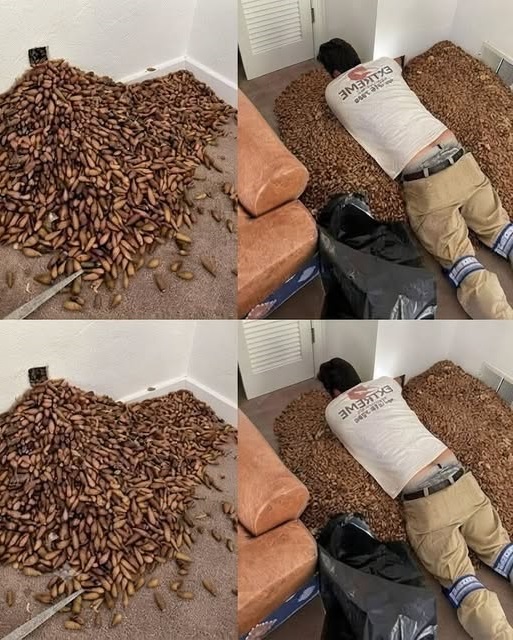
He Opened a Wall Because of a Strange Noise—Then Nearly 700 Pounds of Acorns Came Pouring Out
The Strange Problem Started With Holes in the Siding
After more than two decades working in pest control, Nick Castro had already encountered plenty of unusual situations.
As the owner of Nick’s Extreme Pest Control in California, Castro had dealt with animals getting into homes, unusual infestations, structural damage, and plenty of surprises hidden behind walls.
Still, this particular job managed to catch his attention.
The homeowner had noticed a woodpecker repeatedly drilling holes into the exterior siding.
At first, the problem seemed relatively straightforward.
Woodpeckers commonly peck at wood and other surfaces for different reasons, including searching for food, creating cavities, nesting, or storing food.
But there was something unusual about the way this particular bird was using the house.
The woodpecker wasn’t simply damaging the siding.
She was using the openings as storage compartments.
And what happened inside the wall was about to turn a small exterior problem into an astonishing cleanup job.
The Woodpecker Had Found an Unexpected Pantry
The bird had been collecting acorns.
She would bring them back to the house and place them inside the holes she had created.
From the woodpecker’s perspective, the location probably appeared useful.
The holes provided access to protected spaces, while the hollow areas behind the siding offered plenty of room.
There was just one problem.
The house wasn’t a tree.
Instead of staying neatly inside a natural cavity where the bird could retrieve them later, many of the acorns began falling deeper into the wall.
Gravity did the rest.
One acorn became several.
Several became dozens.
Eventually, the hidden collection became enormous.
From outside, the homeowners could see holes in the siding.
Inside the wall, an entirely different story was developing.
Then Castro Opened the Wall
When Castro arrived to investigate, he expected to find some stored acorns.
He didn’t expect what happened next.
After opening part of the wall, acorns began coming out.
And they kept coming.
The amount was so large that the discovery quickly went from unusual to almost unbelievable.
Instead of finding a small stash, Castro was dealing with an enormous accumulation that had spread through the wall cavities.
As more sections were opened, more acorns appeared.
The hidden pantry seemed to extend much farther than anyone initially realized.
What looked like a few holes in the exterior had been connected to a massive food-storage system inside the home.
The Acorns Reached Toward the Attic
At first, the accumulation appeared to be limited to one section of the wall.
But further investigation revealed that the acorns had traveled much farther.
The stash had accumulated throughout the hollow spaces and reached toward the attic.
That meant the woodpecker had likely been returning again and again, carrying one acorn at a time.
Each individual trip probably seemed insignificant.
But repeated over a long period, those trips produced an extraordinary result.
The bird had essentially turned part of the house into a giant food-storage facility.
Nearly 700 Pounds of Acorns Were Removed
The final amount was estimated at approximately 700 pounds of acorns.
The collection reportedly filled around eight large trash bags.
Think about that for a moment.
What began with one bird carrying individual acorns eventually resulted in hundreds of pounds of food being stored inside a residential structure.
For Castro, who had already spent more than 20 years working in pest control, the job stood out as something very different from the ordinary calls he encountered.
A homeowner had expected help with woodpecker damage.
Instead, the team uncovered what amounted to a massive hidden pantry.
How Could One Bird Store So Many Acorns?
The explanation becomes easier to understand when you consider how the wall was constructed.
The woodpecker was placing acorns into openings in the exterior.
The openings connected to hollow spaces inside the structure.
Rather than remaining near the entrance, some of the acorns fell downward.
The bird could continue bringing more food without realizing that earlier acorns had disappeared deeper into the wall.
Over time, the process repeated itself.
Collect an acorn.
Bring it to the house.
Place it inside the opening.
Return for another.
Thousands of individual movements can create a remarkable accumulation when repeated over time.
The bird wasn’t intentionally creating a problem.
She was simply following her natural behavior.
The Bird’s Hard Work Was Essentially Disappearing
There is an almost strange irony to the discovery.
The woodpecker was working hard to build a food reserve.
She collected the acorns.
She transported them.
She returned repeatedly to the same location.
From her perspective, she had found an excellent place to store food.
But many of those acorns were falling into areas where she couldn’t easily retrieve them.
Her carefully collected food was effectively disappearing inside the structure.
The more she stored, the larger the hidden pile became.
Eventually, the house contained hundreds of pounds of acorns that the bird had accumulated one trip at a time.
Why Woodpeckers Store Food
Some woodpecker species are known for storing food in cavities and other protected locations.
Acorns can be especially useful because they provide a substantial food source.
Natural storage sites may include trees, bark crevices, and other spaces that provide protection.
The problem in this case was that the bird had discovered a human structure offering similar characteristics.
The siding contained openings.
The wall contained cavities.
The house provided protection from weather.
From the bird’s perspective, it was an attractive storage location.
For the homeowner, however, it created a very different situation.
This Wasn’t an Ordinary Pest-Control Problem
One unusual aspect of the job was that the animal wasn’t necessarily trying to invade the home in the way people normally imagine when they hear the word “pest.”
The woodpecker was behaving according to its natural instincts.
That meant the solution wasn’t simply about removing an unwanted animal.
The team also needed to prevent the bird from continuing to use the structure.
A humane approach made more sense.
Instead of harming the woodpecker, the goal was to remove the stored material and make the openings less attractive as a food-storage site.
How the Homeowners Solved the Problem
Once the acorns had been removed, the next priority was stopping the cycle from continuing.
The holes created by the woodpecker were patched.
The homeowners also planned to install new vinyl siding.
That would make the previous openings less accessible and reduce the likelihood that the bird would continue using the same areas.
The solution addressed the source of the problem rather than simply cleaning up the result.
The woodpecker could continue looking for food and a suitable place to store it—but the house would no longer be an easy pantry.
What Homeowners Can Learn From the Discovery
This unusual story offers a useful lesson for anyone who owns a home.
If the same animal repeatedly creates damage in the same location, repairing the visible damage may not be enough.
There could be a reason the animal keeps returning.
Repeated holes in siding, roofline areas, fascia, soffits, or other exterior sections may indicate that wildlife has discovered something useful about the structure.
Animals may use openings for:
- Food storage
- Nesting
- Shelter
- Protection from weather
- Access to hidden spaces
- Raising young
That’s why recurring wildlife damage deserves attention.
If the opening is repaired but the underlying reason isn’t addressed, the animal may simply return and create another opening.
Why Opening the Wall Was So Important
Without opening the wall, the homeowners might have continued seeing holes appear on the outside without understanding what was happening behind them.
The exterior damage told only part of the story.
The real problem was hidden inside the structure.
That is one reason wildlife-related property damage can sometimes be difficult to identify.
A homeowner sees a hole.
An animal sees an opportunity.
Behind the surface, the consequences can continue developing unnoticed.
In this case, the hidden accumulation eventually reached an extraordinary scale.
Nature Doesn’t Always Follow Our Boundaries
The discovery also demonstrates how easily wildlife can adapt to human environments.
To people, a house is a house.
To a bird, however, certain parts of a building may simply look like another potential shelter or storage location.
Wild animals don’t necessarily understand the difference between a natural tree cavity and an artificial cavity inside a wall.
They respond to what the environment provides.
If a location offers shelter, protection, or convenient access to food storage, an animal may continue using it.
That can sometimes produce surprisingly strange situations.
The Most Incredible Part Was the Scale
Finding a few acorns inside a wall would have been unusual.
Finding dozens would have been memorable.
But discovering enough acorns to fill approximately eight large trash bags was something entirely different.
The sheer volume explains why the story became so memorable.
The homeowner likely saw only the evidence on the outside of the house.
Behind that siding was a hidden collection that had been growing one acorn at a time.
By the time the wall was opened, the stash had reportedly reached nearly 700 pounds.
One Woodpecker Turned a House Into a Pantry
What began as a relatively ordinary pest-control call became an extraordinary wildlife discovery.
A woodpecker had repeatedly drilled into a California home’s siding and used the openings to store acorns.
Because the openings connected to hollow wall spaces, many of the acorns fell deeper into the structure.
Over time, the accumulation became enormous.
Approximately 700 pounds of acorns were ultimately removed, filling around eight large trash bags.
The discovery was remarkable not because the bird was doing something malicious, but because a normal wildlife behavior had produced such an unusual result inside a human home.
A Strange Story With a Simple Lesson
The most surprising part of this story may be how ordinary the beginning seemed.
A homeowner noticed holes.
A pest-control professional arrived.
The wall was opened.
Then the acorns started pouring out.
What looked like a small maintenance problem turned out to be an extraordinary example of wildlife adapting to a human-built environment.
The woodpecker wasn’t trying to create a mystery.
She was simply collecting food and storing it wherever she believed it would be useful.
The problem was that the house offered a storage system that worked far better for the bird than it did for the homeowner.
Final Thoughts
Sometimes the biggest surprises in a house are hiding where you least expect them.
A strange noise, repeated hole, unusual smell, or recurring sign of wildlife activity may point to something happening behind the surface.
In this case, the answer was almost unbelievable.
A woodpecker had turned the walls of a California home into a giant acorn pantry.
Nearly 700 pounds of acorns were eventually removed.
The exterior was repaired, the storage openings were closed, and the bird was given the opportunity to find a more suitable natural location.
It is a remarkable reminder that wildlife can be incredibly persistent—and sometimes surprisingly creative.
What looked like a few holes in the siding was actually the entrance to one of the strangest hidden food stashes a pest-control professional had ever encountered.