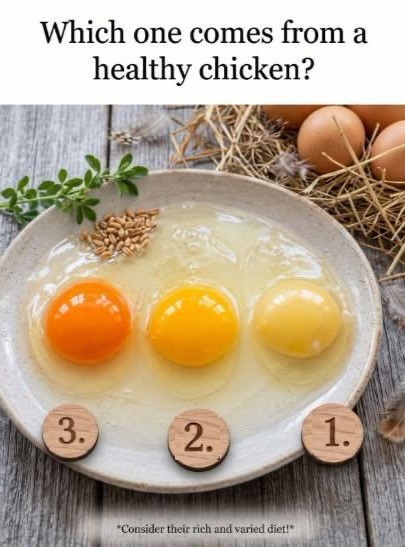
I was halfway through making scrambled eggs one lazy Sunday morning—you know, just moving on autopilot—when I cracked open an egg that practically glowed.
Golden yolk eggs.
I’m not kidding. That yolk was deep golden orange, like it had been kissed by the sun. And for a second, I thought, “Wait… is this okay?”
It looked so different from the usual pale yellow puddles I’m used to scooping out of a shell.
But something about it felt… right.
Natural.
Like this was what eggs were supposed to look like all along.
And down the rabbit hole I went.
Because that yolk? It told me a story.
About chickens. About food. About what goes into that little shell sitting in my refrigerator. And about how little I had been paying attention to one of the most basic ingredients in my kitchen.
And now, I can’t unsee it.
So, What’s the Big Deal With Yolk Color?
Let me break it down real quick—like you’re standing over here at my kitchen counter, waiting for the eggs to finish cooking.
That gorgeous orange yolk definitely catches your attention.
But here’s the part that surprised me:
Yolk color alone does not tell you whether an egg is healthier, more nutritious, organic, or from a happier hen.
I know.
That kind of ruins the simple story a little.
But the truth is actually more interesting.
The color of an egg yolk is influenced largely by what the hen eats. Certain natural pigments, especially carotenoids found in plants, can make yolks appear more intensely yellow, orange, or golden.
So when you crack open an egg with a dramatically orange yolk, you may be seeing a reflection of the hen’s diet.
And that can be fascinating.
But it isn’t a complete report card on the egg.
Why Are Some Egg Yolks So Orange?
The easiest way to understand yolk color is to think about diet.
Hens that consume feed containing more yellow, orange, or green plant pigments can produce eggs with more intensely colored yolks.
Things such as corn, leafy greens, marigold-derived pigments, and other plant ingredients can influence yolk color.
That means two perfectly ordinary hens can produce eggs with noticeably different yolks simply because their diets are different.
One might produce a pale yellow yolk.
Another might produce a deep orange one.
And both can still be perfectly good eggs.
Carotenoids Are the Color Connection
Carotenoids are naturally occurring pigments found in many plants.
You have probably encountered them without realizing it.
They’re responsible for some of the yellow, orange, and red colors found in foods such as carrots, squash, corn, peppers, and leafy greens.
When laying hens consume diets containing different amounts and types of these pigments, some of those compounds can make their way into the yolk.
That’s one reason yolk color can vary so dramatically.
Does a Dark Orange Yolk Mean More Nutrition?
This is where I had to pump the brakes on my original assumption.
It is tempting to look at that deep orange yolk and think:
More color = more nutrition.
But it isn’t that simple.
Yolk color is not a reliable stand-alone measurement of an egg’s overall nutritional value.
A darker yolk may contain more of certain carotenoid compounds depending on the hen’s diet, but you cannot look at the color and determine the egg’s complete nutritional profile.
Protein, fat, vitamins, minerals, and other nutrients are not represented by yolk color alone.
So if you see a pale yolk, don’t immediately assume you’ve got an inferior egg.
And if you see a bright orange yolk, enjoy it—but don’t assume the color tells you everything about the egg.
Do Darker Yolks Taste Better?
Now we’re getting into the fun part.
Because taste is personal.
Some people swear that deep golden yolks taste richer, creamier, or more flavorful.
And I completely understand why.
Eggs from different sources can taste different, particularly when the hens’ diets, freshness, and production conditions vary.
But yolk color itself isn’t a guaranteed indicator of flavor.
In other words, don’t expect an orange yolk to automatically transform your scrambled eggs into a five-star breakfast.
That said…
When you crack open an egg with a gorgeous golden yolk and drop it into a hot skillet?
It sure does make breakfast feel a little more special.
Not All Eggs Are Created Equal
Here’s something I didn’t really grasp until recently:
When you’re standing in the grocery store staring at a wall of egg cartons, the color of the yolk isn’t the only thing worth considering.
There are labels.
There are production methods.
There is the hen’s diet.
There is freshness.
And there is the way the eggs were handled.
Those little words on the carton can tell you much more about the egg than yolk color ever could.
Pastured Eggs
This is where things get especially interesting.
Pastured or pasture-raised systems generally give hens access to outdoor areas where they can engage in more natural behaviors such as pecking, scratching, and foraging, although the exact standards can vary depending on the certification or labeling system.
A hen with access to pasture may eat grasses, leafy plants, seeds, and insects in addition to the feed provided by the farmer.
That kind of varied diet can contribute to more intensely colored yolks.
But here’s the important distinction:
You cannot prove an egg came from a pasture-raised hen simply by looking at an orange yolk.
A richly colored yolk can also result from the hen’s formulated feed.
That’s why the carton label and the producer’s information matter.
Free-Range, Cage-Free, Organic: What’s the Difference?
This is where egg shopping can get confusing.
These labels don’t all mean the same thing.
Cage-Free
Cage-free generally refers to how hens are housed.
It does not necessarily mean the birds spend their days outside.
Free-Range
Free-range labeling generally indicates that hens have some access to the outdoors, subject to the standards that apply in the market where the eggs are sold.
The amount and quality of outdoor access can vary.
Organic
Organic eggs come from hens raised under applicable organic production standards.
Those standards cover more than simply what the yolk looks like.
Pasture-Raised
Pasture-raised generally describes systems where hens have access to pasture or outdoor areas for foraging, but definitions and certification standards can vary.
So if the living conditions of the hens matter to you, read the actual label instead of trying to decode the yolk.
⚠️ Don’t miss the rest! The full article continues on the next page 👇📖
Tap “Next Page” to see all the details, tips, and surprises waiting for you!